I can tell you the time in the night without looking at the clock.
It’s ten past three. It’s always ten past three — and it took me two years to find out why nothing on my nightstand was ever going to fix it.
I fall asleep fine. That’s the part that confuses everybody I try to explain this to.
I’m not lying there for hours at the start of the night. I’m out by ten thirty, easily. Usually before the end of whatever we were watching.
And then somewhere around three, I’m just — on.
 3:07 AM
Not drifting. Not half-awake. On. Eyes open, heart going a little faster than it has any business going in a dark room where nothing is happening. Properly awake, the way you’d be if somebody had knocked at the door.
And then the thinking starts, and the thinking is the insulting part. Because it isn’t big. If I were lying there wrestling with something real I could at least respect it. Instead it’s an email I sent on Tuesday. Something I said to my sister in 2019. Whether I moved the laundry over.
And underneath all of it, running the entire time like a ticker along the bottom of a news channel: four hours and fifty minutes until the alarm. Four hours and twenty. If I go to sleep right now, three and a half.
You know that math. Nobody who sleeps properly has ever once done that math.
Then around five I finally go under — properly, heavily, the best sleep of my whole night — and the alarm takes it off me forty minutes later. And I get up, and I’m the tired one at work again.
I did everything you’re supposed to do. I want to be clear about that, because I know how this sounds.
Cold room. No phone after nine. Blackout curtains that cost more than I’d like to say. Caffeine cut off at noon, then at ten, then cut out entirely for six weeks to prove a point to myself. No wine — and I’ll come back to the wine, because the wine turned out to be interesting.
I had the sleep hygiene of a Swiss clinic and I was still awake at ten past three.
I went to my doctor about it twice.
I’m not angry at her. She had eleven minutes and I had one complaint that doesn’t show up on any test she can order. But I walked out of that room both times having absorbed the thing you absorb in that room — that this is a me problem. That other women my age are handling it. That I am, essentially, making a fuss about being a bit tired.
So I did what everybody does next. I bought things.

Melatonin. Ten milligrams, because five wasn’t doing anything — and neither was ten, except that it made me thick and slow until eleven the next morning. And I still woke up at three. Just groggier when I did.
Magnesium. Two different kinds. One of them caused a problem I won’t describe here.
Ashwagandha. Chamomile tea, which I still drink and still love and which does approximately nothing. A nighttime cold-and-flu liquid I took twice and felt hungover from both times.
And the wine. Which absolutely knocked me out, and which — I found out much later, and it made a great many things click into place — is well known for doing exactly this: dropping you off beautifully, then waking you in the small hours when it wears off.
I had been medicating myself into the precise problem I was trying to solve.
- Melatonin, 10mg — six bottles$84
- Magnesium — two kinds, one returned$41
- Ashwagandha$28
- Chamomile tea — a box a month$72
- Nighttime cold-and-flu liquid$12
- Blackout curtains$180
Somewhere around eight months in, I sat on the edge of the bed and actually looked at that nightstand, and something occurred to me that I have not been able to un-see since.
Every single thing on it was built to get me to sleep. And I don’t have that problem.
That’s the promise on every one of those boxes. Fall asleep faster. Drift off. Unwind. Every product I owned was solving the first problem.
I have never had the first problem. I fall asleep like a stone. My problem happens four and a half hours later, and not one thing I had ever bought was even pointed in its direction.
That was the week I stopped shopping and started reading.
What nobody had told me
Your brain has a brake pedal.
It’s a system called GABA. It’s the thing that quiets neurons down — the reason your head goes soft and slow and stupid when you’re settling into sleep. It isn’t a mood. It’s a mechanism, and it’s meant to stay on all night.
And progesterone is heavily involved in holding it down. Not in the way you learned about progesterone in school — this is a different job entirely. When progesterone breaks down in the body, one of the things it becomes settles onto those same GABA receptors and helps keep that brake held through the night.
Progesterone starts shifting in your forties. Often well before anything else does, and usually years before anybody says the word perimenopause to you. Mine started at 44, and the first sign wasn’t a hot flash. It was this.
And the brake gets lighter at exactly the point in the night when two other ordinary things are already happening — your cortisol has begun its slow climb toward morning, and your blood sugar has been drifting down for six hours since dinner.
None of that is a disorder. It’s a set of completely normal overnight mechanics that used to be covered, and now aren’t quite.
That’s ten past three. That’s the whole thing.
It isn’t stress, it isn’t a character flaw, and you have not somehow forgotten how to sleep. You’re just not supported through the second half of the night the way you used to be.
I had a short and fairly intense moment of being furious about the two years. Then I went looking for something with GABA in it.
That turned out to be harder than it sounds
Nearly everything on the shelf is one of two things.
The first is melatonin and basically nothing else. And melatonin is a timing signal — it’s the thing that tells your body it’s night. It’s genuinely useful at the front of the night, for the first problem. It is not a brake. Taking more of it doesn’t buy you a brake. It buys you a heavier morning, which I can personally confirm at both five and ten milligrams.
The second is a “proprietary blend” — eleven lovely-sounding botanicals on the front and no amount of any of them printed anywhere.
Which stops being subtle the moment you notice it. If the number were good, the number would be on the bag.
And then there’s the viral cocoa. The sleepy hot chocolate everyone was posting about. I bought that too.
I’ll be fair about it: it’s a decent product. Real ingredients, doses actually printed, and it tastes nice. It’s also sixty-five dollars, mine clumped no matter how I stirred it, and I got about three weeks out of a bag that says thirty nights.
And there’s no GABA in it. Which by that point was the only thing I was shopping for.
What I ended up with
A cocoa called SOVIA — and I ended up with it for an unromantic reason. It was the only one whose label answered every question I’d built up.


Six things. Every dose in milligrams on the label. I didn’t have to take anyone’s word for anything, which after the year I’d had was most of the appeal.

Plus real cinnamon and cocoa — which does something useful for that overnight blood-sugar drift, and is also, conveniently, why it tastes like something you’d actually want at ten at night.
What it was actually like
I’ll tell you honestly, because I’d want to know.
The first night, nothing. I want to say that clearly. If somebody tells you their sleep supplement worked on night one, take a step back from that person.
Fourth or fifth night, I woke up and it was quarter to six. I lay there for a moment genuinely trying to work out what had gone wrong.
It isn’t every night, even now. I still get the occasional ten past three, usually when there’s something real going on. The difference is that it’s a bad night now, rather than the shape of my entire life — and when it happens I’m back down inside twenty minutes instead of touring my own regrets until five.
The mornings are the part I didn’t expect. I come up clear. Not fogged, not dragging, not needing forty minutes and a coffee before I’m a person. I’d assumed that was the trade.

One scoop, warm milk or water, thirty seconds with the frother. It replaced the glass of wine, which as established was actively working against me. The frother comes free in the box — which sounds like a gimmick right up until you’ve had a cocoa that clumps.
I’m not the only one
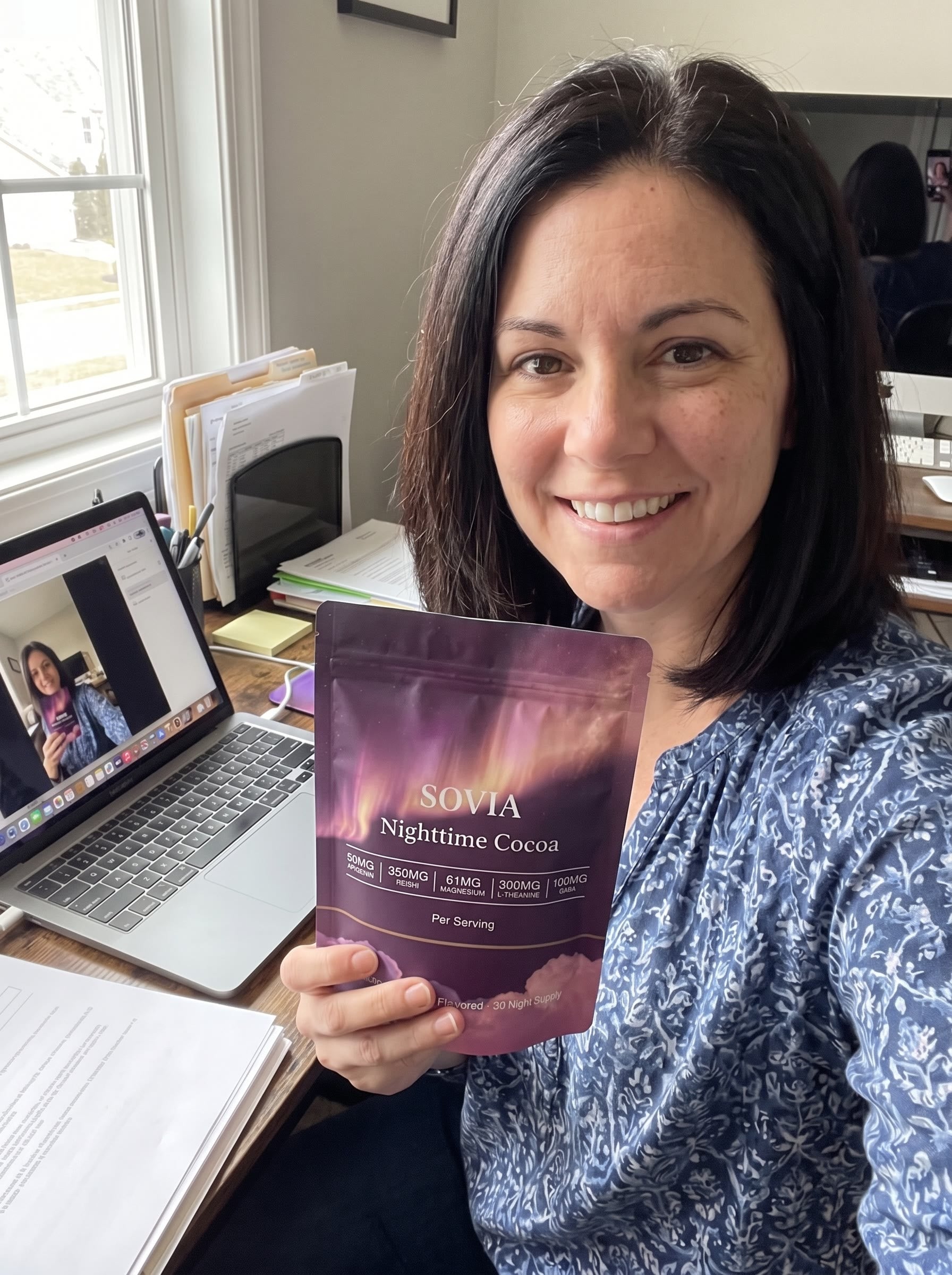
“I’ve struggled with waking up at 2–3am for years. After the first week of Sovia, I started sleeping straight through until my alarm. It’s been 6 weeks now and I honestly can’t believe the difference. My husband even noticed I stopped tossing and turning.”
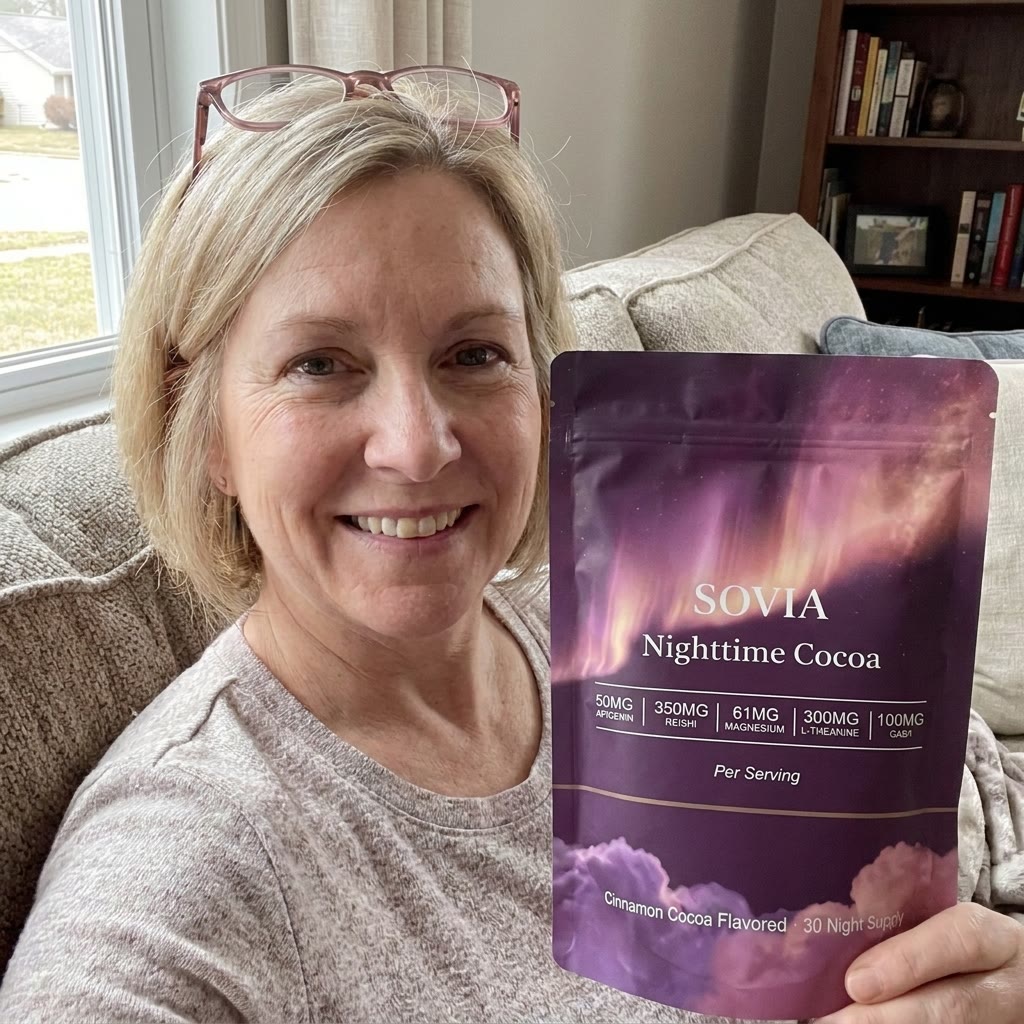
“At 54, I’d accepted that poor sleep was just part of getting older. My daughter bought me Sovia as a gift and I was skeptical. Three weeks later, I’m sleeping deeper than I have in a decade. I wake up actually feeling rested, not just awake.”
What it isn’t
- It isn’t a sedative. It doesn’t knock you out and it isn’t meant to. The aim is calm, not sedation — and no fog the next morning.
- It isn’t a subscription. One order is one order. Nothing recurring, nothing to cancel, no card quietly charged in 30 days.
- It isn’t a hormone product. It supports your own GABA activity and your own wind-down — it doesn’t contain or replace hormones.
- It isn’t for everyone. If you’re pregnant, nursing, taking medication or managing a health condition, speak to your doctor before starting anything new.
- Nighttime Cocoa — 30 nights$39
- SOVIA Electric Milk FrotherFREE
- The Sleep Ritual GuideFREE
- ShippingFREE
Questions I had
Will I feel groggy in the morning?
That was my main worry, and it usually comes from high-dose melatonin gummies — 10mg is a typical supermarket dose, and I know exactly what it feels like. SOVIA uses 5mg, timed to clear before morning, with the rest of the work done by calming ingredients rather than sedating ones. “Not drowsy, not foggy, just calm” is the phrase that comes up most.
How long before I noticed anything?
The calm from L-Theanine and apigenin turned up the first evening, within about 20–30 minutes. Staying down through the night took me until the fourth or fifth. Most people talk about the real difference at two to three weeks of consistent use.
Is it habit-forming?
No. There’s nothing habit-forming in the formula. Many people drink it nightly because they enjoy it; others use it on the nights they need it.
Can I take it with my other supplements or medication?
Please check with your doctor or pharmacist, particularly if you take sleep, blood-pressure, blood-thinning or sedative medication. Better to ask than guess.
What does it taste like?
Cinnamon cocoa. Genuinely like hot chocolate — that’s the point. No artificial sweeteners, and it froths smooth rather than settling into grit at the bottom.
One last thing
If you’re reading this at some ridiculous hour with the brightness turned right down so you don’t wake him — hello. I know exactly where you are. I was there for something like seven hundred nights.
You’re not making a fuss. You haven’t forgotten how to sleep. Nothing about you is broken. And the fact that nothing has ever turned up on a test is not evidence against what you’re experiencing — it only means nobody’s been measuring the right thing.
You’ve been buying things designed for the first half of the night. Your problem is in the second half.
These statements have not been evaluated by the Food and Drug Administration. This product is not intended to diagnose, treat, cure or prevent any disease. Individual results vary. Consult your physician before use if you are pregnant, nursing, taking medication or have a medical condition.